Search This Blog

Showing posts with label natural perfume. Show all posts

Friday, March 29, 2013

Buy Baby Buy - Spend Baby Spend: Stage 2 of Launching a Retail Business

Dear Reader,

Here Lies Charna Ethier.  We find her lying on the floor of her soon to be open commercial space, with blistered fingers, muttering something that sounds like garbled Swedish: "Klingsbo! #@% What the?  Tjusig! Allen wrench . . . aargh!"


The past two weeks have been spent building IKEA display units, hanging blinds, installing lighting fixtures, and reading instruction manuals.

The cash register has been delivered.  The phone and internet have been installed and turned on.  You promptly realize the internet has been installed in the wrong location as the new cash register from square must plug directly into the modem.  Sigh.

The new stool that should have been so easy to put together . . . well not so easy.  It comes in four pieces--should be easy breezy right?--has taken two hours to put together.  You promptly realize it's too short.  When you sit on your stool behind the cash wrap your neck is waist high to the customer on the other side.  Creepy.  You are so tired you decide to keep the stool.

An enormous amount of tools are needed.  Wire strippers, hammers, levels, drills, industrial strength velcro (more on this later.)  I have realized one important concept, it IS possible to build a retail space on a budget but it involves lots and lots of time and sweat equity.
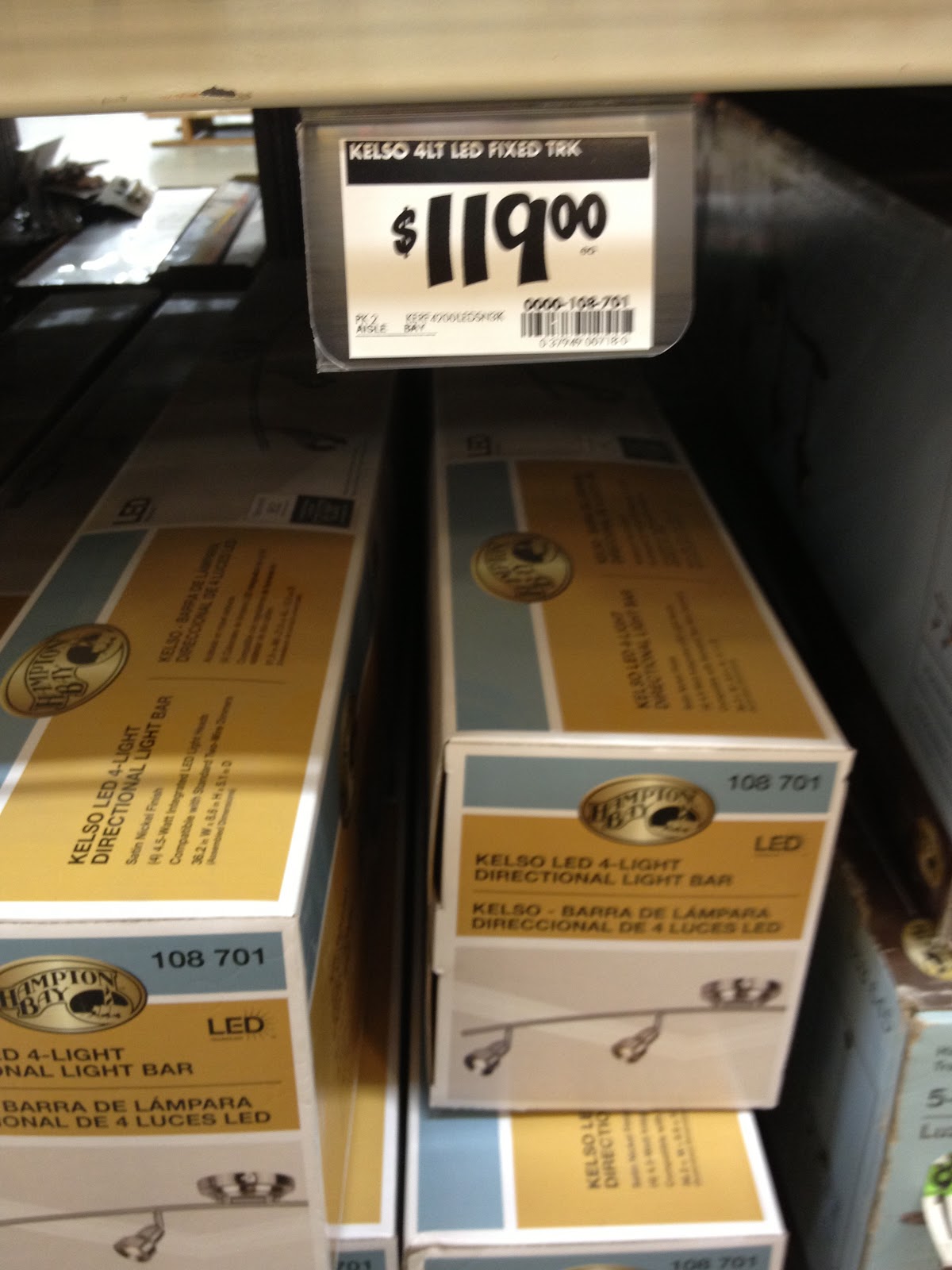
Howdy Home Depot


LIGHTING
Lighting is one of the most important aspects of retail.  Instead of boring you with the details of my complicated track lighting purchase (suffice to say I decided on LED track lighting which costs more initially but is eco-friendly and energy efficient) I shall regale you with a more glamourous lighting purchase: the chandeliers.  I found an incredible deal online for a stunning chandelier.  I had looked at the very same chandelier in a local lighting shop and found it for hundreds of dollars less online at amazon.com.  Now, I knew there would be some assembly involved with the online chandelier as a local lighting shop explained that they only sold the chandeliers assembled and that they charged a few hundred additional dollars to do so.  Being the frugal shopper that I am, I decided I would order the chandelier online and assemble it myself.

LED track lights installed
Purple crystal chandelier over cash wrap


The good news: the chandeliers arrived in perfect condition!  The bad news: perfect, unbroken 985 piece condition!  The chandeliers also had to be wired and the instruction were not printed in English.  This required stripping the wires as carefully as possible to avoid breaking the fragile glass arms and connecting all the left wires together and all the right wires together.  Luckily my husband Dan did this for me.  Side note: I did initially start to try and strip the chandelier wires, hitch them together, cap them etc. but my husband stared at me, snorted and commented, "Wow Charna.  You look like you're playing the game OPERATION.  Your hands are shaking.  You know there's no electricity actually connected to the chandelier, right?  Just pass me the wire strippers."  Score!

Next the chandeliers had to be hung (again I happily opted out of this process.)  Finally all 900 little crystals had to be hung on the chandelier, along with strings of crystals.  I was on my own for the final step.  The clasp on each crystal had to be individually pried open with needle nose pliers, hung and squeezed closed.  This took seven hours.  Seven hours of sitting on top of a ladder, connecting strands of crystals, counting each bead to make sure all the strands were even, adding little metal jump rings, prying the metal rings apart with pliers and attaching them equally along the arms of the chandelier.

The final result is pictured below and no matter what anyone says, I will swear it's the best looking "snow white" chandelier I've ever seen as I devoted an entire day of my life to assembling it.


Snow White Chandelier


SIGNAGE
I contacted a few local sign makers for quotes for an outdoor hanging sign.  In the process I learned more about carved signs than I ever imagined.  I discovered that Mahogany is the only type of wood that should be used for a sturdy outdoor hanging sign as it is most impervious to the elements.  I learned of smaltzing, a process of using ground glass paint that resists sun fading.  I learned red, blue and consequently purple colors fade the most quickly on outdoor signs.  I learned that while gold leafing is very popular on carved wooden signs, silver leafing is not recommended as it will tarnish outdoors quickly.  I learned that carved wooden signs are very expensive.  I learned that I could not afford a carved wooden sign.

I ended up ordering a sign that is not made from wood but looks like a carved wooden sign.  This type of hanging sign costs almost half of what a mahogany wood sign retails for.  The sign I've ordered is a 3 foot circular purple sign with my logo printed in silver (but not silver leaf.)  I found it interesting when looking for signage that there are few options in the middle price range.  It seems you spring for an expensive sign or your other options are few and far between, such as a plastic banner.

Outdoor hanging sign ordered and due to be delivered in a few weeks, I proceeded to have window laminates made as the shop is on a busy street and the sign may not be visible while driving as it hangs perpendicular to the street.  The window stickers were hung as soon as they were printed as I worried about having deliveries made to the new shop with no signage.  Once the window stickers were in place I felt a huge sense of euphoria.  The shop felt tangible.  I'm embarrassed to admit I teared up for a moment and hugged the sweet grandfatherly Italian sign maker causing him to blush.  My logo in the window!  I felt such a sense of accomplishment.  I am here!

sweet sign maker posting hours on the front door

silver window laminates pre-installation

applying the front picture window


Here are the shop windows from outside:


After the window stickers were applied I promptly covered the windows with paper, so the mess inside wouldn't be visible from the street.  Once or twice I forgot to lock the front door after receiving a delivery, and people would walk into the shop which was alarming.  I realized quickly I needed to make it clear we weren't open yet and hide the construction inside.

My next step was to finish buying, moving and assembling the furniture.  I decided on a white somewhat modern style.  Having a single color palette made things easier for me.  The bulk of the displays were purchased at Ikea and we visited often enough that the kids developed a fondness for elderflower juice and cinnamon buns the size of their heads.  I knew I was in trouble when I stopped getting lost in Ikea.  After providing particularly helpful directions to a couple seeking discounted Expedit bookshelves, I realized I needed to leave Ikea and not return for some time.

Next installment: "Finishing Up, Why Having A Flexible Launch Date is Important" otherwise entitled "You Didn't Actually Think You Would Open On Time Did You?"

Click here to visit our website.

Tuesday, October 2, 2012

Adventures in Natural Candle Making

By Charna Ethier from Providence Perfume Co, we make 100% natural perfumes.


When I decided I wanted to create a few naturally scented candles for the holidays I had no idea what I was getting myself into.  I expected my foray into candle making to be fun and somewhat challenging.  A little bit or trial and error I thought.  I thought wrong.

Being a natural perfumer I knew I wanted to create naturally scented candles.  I wanted to use essential oils and floral waxes to scent the candles.  I knew I would have an uphill battle in getting the candles to "throw" scent using no fragrance oils.  In addition I wanted to use soy or beeswax to create the candles as eco-friendly as possible. I also wanted the candles to smell amazing.  I have yet to piece all three aspects into a wildly successful BURNING candle.  


I'm going to break my candle making process into four main components: Wax, Wick, Scent, Burn.

WAX: ah, the controversy!  

  • Soy wax is considered eco-friendly, burns cleanly but is apparently made from genetically modified soybeans. Thanks Monsanto!  Soy wax is considered one of the most difficult waxes to pour with and apparently many "newbies" to candle making become frustrated with soy wax as using it can require multiple pours and little aroma.  In my experience soy wax also produces the least scent throw of all waxes.  It literally swallows up essential oils.  And, if you add too much fragrance--watch out!  (More on this later.)
  • Paraffin wax is created from petroleum distillation.  Bad for the environment and does not burn cleanly.  It holds lots of fragrance and throws scent very well.  Damn you paraffin!
  • Cream wax is a version of paraffin wax that possesses a creamy texture, is very easy to use, typically requires one pour and holds the most amount of fragrance.  I believe cream wax is often used in many high priced designer candles that I seem to be attracted to.  Candles that cost more than a good bottle of wine.  These candles have a very soft consistency and can permeate an entire room quickly with fragrance.  Too bad this wax is paraffin based.
  • Beeswax is the most expensive wax, priced at about $10.00 per pound.  FYI, 1 pound of wax will typically fill one-two large size candleholders.  Beeswax can be bought yellow/golden and unfiltered possessing an amazing honeyed beeswax aroma or processed and bleached white.  Beeswax candles burn forever!  Beeswax seems to be able to hold a good amount of fragrance but seems to have trouble "throwing" the scent.  Beeswax candles possess a very hard wax consistency and burn the longest in my experience.
I ordered bags of four different types of soy wax.  From Cargill's Nature Wax to Golden Foods 444.  Two additional soy waxes that were recommended to me were Soy-125 and Soy-135.  After working with them I noticed . . . nothing.  Umm, seriously I couldn't tell the difference between them.  I tried to note if one type of wax burned longer than another or if one wax seemed to hold or throw fragrance better and, I really could not detect differences between them--but don't forget I'm a novice.  To my eye, no wax seemed to leap out as being better than the rest.  (It didn't help that I was constantly changing the fragrances of the candles from batch to batch.)

After my experiments with soy and beeswax, I decided to work with mixing the two.  The difficulty came in what proportion to mix the beeswax and soy wax.  After some experimentation, I think I like 3/4 soy and 1/4 beeswax or even 2/3 soy to 1/3 beeswax.  The small amount of beeswax allows the candle to burn longer, imparts a slight honeyed aroma and increases the amount of fragrance load one can add to the wax.

WICK: the most important part of creating a successful candle.  Who knew?  Alas, not me :) I'd like to thank Nikki Sherritt of Gabriel's Aunt for all her assistance.  Nikki is the owner of a successful natural candle line called Gabriel's Aunt. I've sampled her candles and found them to be top of the line.  I booked a consultation with Nikki last year to discuss candle making and quickly realized I might be over my head.  While making candles may not seem difficult, it is difficult to create naturally scented candles that burn well and smell good and Nikki is an expert.  She stressed the importance of finding the correct wick, experimentation, and sticking with the same size container.  

Side note - I consider Nikki a friend.  She is such a doll that she recently fielded a phone call from me that went something like this: 

Nikki 
"Hi Charna.  Yes, I got the text with the pictures you sent of your candles.  Um, well I wouldn't call them Frankenstein candles, but ah maybe they cooled too quickly? 
Me (sullen) 
"They're MONSTER candles!  Admit it.  Hey, what's that noise?"

Nikki 
"That's a tow truck.  I'm on the side of the road.  My truck just broke down."

Me (embarassed) 
"Oh, sorry Nikki. I'll let you go.  Ah, good luck with your wedding next week?"

Scene ends with Charna realizing that Nikki is indeed a saint and Charna is indeed neurotic.

Back to wicks.  Wick size is chosen based on the diameter of the candle, along with the type of wax used.  Thus far, my favorite wick for soy and wax candles in glass jars measuring about 3 inches across is RRD-47 or RRD-55 from candlewic.com  Did I mention that candle making was more difficult than I anticipated?

One tip I discovered along the way is to use a slightly larger than average wick when creating candles made with soy and or beeswax.  The larger thicker wick seems to burn better in bee/soy and create a larger pool of wax increasing scent throw.  Is it just me or is this candle making endeavor becoming more complex by the minute?


SCENT: sigh.  A general rule of thumb is to add one ounce fragrance per pound of wax.  These guidelines are for fragrance oils which is where it gets complicated.  Weighing your ingredients, just as with making perfume is advisable.  Some waxes are able to hold more scent, some less.  I like to add as much aroma as possible but am still not thrilled with the amount of fragrance my candles possess.  If you add too much fragrance the candle will not burn.  Take it from me and don't try to add anything thick like benzoin or labdanum.  The candle smelled INCREDIBLE.  The candle did not burn.  Not one bit.

Beware the dreaded citronella complex.  The citronella complex occurs when you add a variety of lemony or spicy essential oils to the wax.  The aim is sophisticated freshness.  The result is Walmart tikki torch.  As your spiced citrus scented candle cools, it smells wonderful.  Enjoy these fifteen minutes or so of pleasant aroma as they will be your last.  Beware the lighting of the candle the next day as you will smell the repellant aroma of citronella somehow wafting from your candle made with any of the following oils: coriander, black pepper, juniper, litsea cubeba, ginger, bitter orange.  You have just created a very expensive citronella-like bug repellant candle.  Sad times.


I'm still experimenting with adding floral waxes to the candles.  It seems to be the only economical way to add faint floral aromas to the candle.  It would be cost prohibitive to add rose or jasmine as they are so incredibly expensive, but high quality floral waxes add a soft roundness to candle aroma.  More on this another time.

BURN: As I've mentioned earlier the type of wax and wick one chooses for their candle has a great deal to do with how long the candle burns.  The container or candle holder also determines candle burn time and success rate.  I am only experimenting with container candles, so I can only speak on my experiences with this type of candle.  I've noted that candle containers that are tall and skinny (like the candles with saints and religious vows printed on them) are harder to master.  Candle holders that are short cylinders or have a wide mouth seem a bit easier to burn.  I've wondered how accurately one can record burn times of candles?  Will I have to burn the candle in four hour intervals to accurately gauge how long the candle will burn for?


I can recommend sticking with one type of container for experiments with candle making.  Each time you change the candle holder, you must change the wick and some waxes and wicks work better in different styles of containers.  To cut down on the confusion, I've found sticking with one container is best.  I'm currently working on mastering one scent, with one wick in one container.

Wish me luck.  Oh, and if anyone's interested in purchasing some overpriced citronella scented candles, let me know.

p.s. the talented Marla Bosworth also provided assistance in my candle making.  I think I may be a lost cause.

Charna also makes natural perfumes, her company is Providence Perfume Co.

Monday, September 3, 2012

Unsolicited Advice is . . . unsolicited

 By Charna, Providence Perfume Co - 100% all natural perfume

"You should try and make your perfume's lighter.  They smell too old-ladyish."

"You know what your next fragrance should be called?  Xylophone!"

"I wish that you would make something that smelled more like perfume X."

"I wish you would make something that smelled less like perfume X."

"Are you that lady that makes all natural perfumes?  What do you have that smells like Tommy Hilfiger?"

"Are you wearing one of these perfumes that you made?  I'd like to smell it on you.  Maybe on your neck?  Are you single?"

"Why don't you try selling your perfumes at farmers markets or craft shows?"

"You should make your perfumes cheaper."

"I don't like natural perfumes.  Why can't you make something that smells like perfume X?"

"I wish you would make your perfumes lighter.  They're too strong for me.  Why don't you make a light pretty perfume?"

"I wish your perfumes lasted longer.  They fade too fast.  Have you considered making them stronger?  When I wear Curious, by Britney Spears it lasts all day!"


I've heard (or overheard) all the following comments in the past month.  Being a micro business owner requires a thick skin.  If someone doesn't like your logo or your labels or your product or your website the blame falls squarely on your shoulders.  There's no blaming Ted in accounting for a clerical error.  All business decisions are made by you.  When people offer you their sincere unsolicited advice on your business it's hard not to be offended, especially when they're criticizing something you've created.  Something that speaks to you.  Something you've toiled over and offered up on a silver platter.


And therein lies the dilemma!  It can be hard to separate ourselves from our product.  I remind myself that there is no pleasing everyone.  I do appreciate feedback, but in the end I make my own choices.  I put my head down and stick to my guns.  I try and trust my intuition and remind myself that it's gotten me this far.

Monday, August 6, 2012

Providence Perfume Co. Launches New Scent: Divine Noir


Providence Perfume Co. Debuts Divine Noir Eau de Parfum

Vintage Inspired 100% Natural Perfume


PROVIDENCE, RI, August 04, 2012 /24-7PressRelease/ -- Providence Perfume Co. will debut their new all natural perfume DIVINE NOIR on August 7th.

The fragrance Divine Noir is a darker foil to the natural perfumery's popular orange blossom scent Divine. Divine eau de parfum, composed by perfumer Charna Ethier is an ode to a glamorous friend who is never without her red lipstick. Divine Noir is a deeper, richer interpretation of the original Divine fragrance. Divine Noir is the little black dress worn after dark.

"My Grandmother's dressing table, with its ever present bottle of Youth Dew perfume captivated me as a child. What mystery that dark perfume held! The deep brown liquid evoked glamour and drama. Without even smelling the perfume, there was an anticipation of enigmatic elegance. In composing Divine Noir, I wanted to capture the sensuality and style of a bygone era using luxurious natural ingredients," Charna Ethier explains.

Ms. Ethier created a dark Madagascar vanilla bean tincture, and built an interesting rootbeer like accord with the addition of sarsaparilla, aged patchouli and liberal amounts of oakmoss into the composition.

Top Notes: bitter orange, coriander, bergamot
Heart Notes: orange blossom, neroli, jasmine grandiflorum, rose absolue
Base Notes: oakmoss, angelica, vanilla bean, elemi, aged patchouli

Divine Noir eau de parfum will be available online at http://www.providenceperfume.com and at select stockists beginning August 7, 2012.

Providence Perfume Co. is an independent 100% natural perfumery devoted to creating artisan perfumes utilizing the finest essences available. Perfumes are hand blended by perfumer Charna Ethier who has garnered global recognition for her innovative natural fragrances.

To learn more, visit http://www.providenceperfume.com or call 401-256-8272. Please contact Charna at Providence Perfume Co.: info@providenceperfume.com
###

Friday, June 29, 2012

Pantone Perfumes: A Guide For Creating Colorful Perfumes


By Charna from Providence Perfume Co., 100% natural perfume


Lady Gaga and I have precisely one thing in common: a black perfume in our roster.  According to a recent press release, Gaga is launching a new black hued perfume called Fame which morphs from black to clear when sprayed.  Hmmm, the wonders of modern chemistry?  My perfume is nearly black (and stays that way) from the addition of lots of delightful dark essences such as oakmoss and black tea. 


I've noticed a slew of colored perfumes being launched by the mainstream perfume industry of late and it pleases me immensely. This is a trend I can get behind.  If there's one thing we natural perfumers do well it's colored perfumes!  Now to be fair, these mainstream perfumes are artificially colored.  However, nature provides a wide spectrum of colors for the natural perfumer to paint with.  In fact, it's often difficult to create a natural perfume that isn't colored.  As a perfumer I made a conscious decision to use any essence I desired when creating my line, regardless of how its addition effected the final color of the perfume.  If I were to limit myself to using clear oils and absolutes I'd be left with only a handful of essences to work with.  I wish to expand, not reduce my palette.  This meant I would have accept that my natural perfumes were sometimes dark brown, or black or green when filtered.  

Despite the fact that I had accepted these colored perfumes, I wondered how potential customers would react.  Would consumers be less likely to purchase my Osmanthus Oolong eau de parfum because it was a dark gray color?  Would the jade tone of Tabac Citron quell sales?  My line has a distinct voice and color; perfumes so very different than the mainstream perfume industry.  Artisanal fragrances.  Perfumes made in small batches, by hand using incredibly rare, expensive natural essences that just so happen to be brightly colored.  I'm happy to report that little fuss and few comments have been made about the colors of my fragrances.  I expected the colors of the perfumes to be more off putting to the consumer than they seem to be.  Acceptance!  I have been asked on occasion if I dye my perfumes, to which I reply, "No, Mother Nature does."


As for me?  I'm drawn to the mystery of a dusky scent.  I'm tired of girly fruity floral scents.  Hygienic clear bottles of scent hold no promise for me.  Be gone era of clean, clear perfumes meant to evoke purity.  I'm a vintage perfumista at heart.  Bring on the deep, dark, richness of amber colored perfumes!  While Estee Lauder's Youth Dew may not be my favorite scent, the fascination I feel when gazing upon it's dark liquid is palpable.  Without even a sniff, Youth Dew makes it apparent that it's rich and deep and resinous.  What secrets are locked inside that dark brown nectar?  

So, along these lines I've created a quick perfume color guide.  The following botanical essences possess serious color saturation.  Adding more than a few drops will color a perfume quickly.  In you've ever wondered why or how a natural perfume obtained it's hue read on.


GREEN: lavender absolute, lavender seville absolute, green tea absolute, violet leaf absolute, tobacco absolute, mint absolute, sweet clover absolute, rooibos (red tea) absolute, fir balsam absolute, geranium absolute, rosemary and basil absolutes.

BLUE: blue tansy, chamomile

ORANGE: rose absolute, pink lotus absolute, tuberose absolute, boronia absolute, immortelle absolute.

YELLOW: genet (broom) absolute, jasmine grandiflorum absolute, saffron absolute, 

BROWN/BLACK: black tea absolute, cocoa absolute, coffee, angelica absolute, oakmoss absolute, cedarmoss, cedarwood absolute, vanilla absolute, labdanum.


Wishing you technicolor perfumed dreams.

If you have any questions about a natural fragrance or natural perfumes please contact Charna at providenceperfume@gmail.com. 


Friday, June 1, 2012

My First Love - JASMINE!


Providence Perfume Co. is an all natural perfume company.


I'm mad for Jasmine.  Simply infatuated.

I can't recall the first time I smelled the lush aroma of Jasmine.  I grew up in New England, a region not exactly famous for it's jasmine cultivation.  I believe my first contact with Jasmine would be as a teenager working the perfume counter at Macy's.  I went wild with smelling every perfume I could.  I sniffed every exotic gorgeously packaged mainstream perfume I had missed out on growing up in a small rural town.  The perfume counter at Macy's was glamour and glitz and sophistication.  I found myself drawn to a variety of scents and they all had one note in common: jasmine.

Now I realize what I was huffing was most likely synthetic jasmine.  It wasn't until I was a bit older that I actually smelled real jasmine absolute.  Jasmine absolute is so incredible, so creamy and full and plump; in my opinion it's aroma is unable to be wholly duplicated by aroma chemicals.  In Jean-Claude Ellena's book Perfume, the Alchemy of Scent he comprised a pared down list of essences he uses for perfumery he calls "The Collection."  The list is smaller than you might expect.  I found it interesting that along with Jasmal, Jasmolacton and Jasmonal H (synthetic jasmines) Ellena also lists Jasmin absolute and Jasmin Sambac absolute.  It's also interesting to note that Jasmine is the only aroma included in the collection in five different compilations.  From this we learn that Jasmine is IMPORTANT to perfumery and that real Jasmine absolute is UNDUPLICATABLE.


Fast forward a few years and I find myself working for Aveda surrounded by real Jasmine.  I was in jasmine heaven.  During this time I found that jasmine possesses universal appeal.  While many customers wrinkled their noses at the scent of patchouli and even rose, they smiled when sniffing the sweet aroma of jasmine.  I learned my lesson well.  Even now, when blending a custom scent for a more err  . . . challenging client I reach for the jasmine.  When all else fails, jasmine triumphs!

There is a jasmine for every preference.  Sweet jasmine, musky jasmine, dirty jasmine, filthy jasmine.  When teaching Introductory Natural Perfume classes, I'll often pass around a bottle of unlabeled jasmine grandiflorum for everyone to smell.  When I ask the class what essence they think they're sniffing many will guess correctly it's jasmine.  I'll then pass around bottles of jasmine sambac, jasmine flexile, jasmine auriculatum.  Silence.  Many haven't smelled these jasmines.  Many are surprised that jasmine can vary so wildly in aroma.  We talk of indole and jasmine.  We laugh.

- Jasmine is present in many of my perfumes.
- Jamine's beauty beckons me.
- Jasmine blends well with all essences.
- Jasmine is a team player. In perfumery jasmine is happy to take a supporting role or be a star.
- Jasmine is indispensable and important.
If you have any Jasmine absolute, go grab it and take a deep long sniff.  See what I mean?  It's just that good.

In celebration of the Natural Perfumers Guild sixth anniversary blog event, the following perfumers are participating by sharing stories of their first love.  From sandalwood to rose, be sure to check these articles out (see below.)


http://perfumebynature.blogspot.com

http://anyasgarden.blogspot.com

http://www.matriarch.biz/blog.html

bellyflowers.blogspot.com

http://www.roseenbos.com/category/blog

www.lesparfumsisabelle.co.uk

http://joannebassett.com/natural_perfumes

www.oneseedcompany.com

http://ellenoire.blogspot.ca

http://africanaromatics.com/int/

Visit our website to learn more about natural perfumes or contact Charna at providenceperfume@gmail.com.

Sunday, November 13, 2011

Gee, you smell terrific!

Providence Perfume Co., an all natural perfumes company


In a recent interview, I was asked the question: "How do you know when you've created a remarkable scent?  How do you know when you've hit a proverbial perfume home-run?"  I was perplexed.  I paused, and then realized I had no idea what to say.  I stumbled a bit and then awkwardly fell back on the only truthful answer I could give: "There's no way to tell."

I wish I was constantly stopped and asked by strangers, "What is the incredible scent you are wearing?" or told, "Gee, you smell terrific!"  I'm not.  In all fairness, I wear less perfume than I used to.  I spend so much time blending, and working on perfumes I can't wear fragrance that will interfere with my sense of smell.  I've made the mistake of using a scented lotion or shower gel and then applying a perfume I'm working on.  I'll puzzle over the fact it smells differently than it did the day before, only to realize I've applied a scented lotion that morning.  I've learned to be careful with what I wear when I'll be working.  I do wear fragrances when I go out to dinner or to meet friends for a drink, and sometimes just to run errands especially if I'm feeling slovenly.  As if a spritz or two of perfume will make strangers forget I'm wearing yoga pants and uncombed hair!  I do love perfume, however I'm now careful of when and where I apply it - ah, the classic perfumers dilemma.


On a humorous note, I have had the opposite reaction to being perfumed.  Recently, I was pouring large batches of solid perfumes for a wholesale order.  I had been working on filling the solids all day and was pouring larger quantities than normal.  The hours flew by and before I knew it, it was time to pick my kids up from kindergarten and I was late.  I raced to the car and drove quickly to the school to pick them up.  As I exited the car, the teacher's aide who was waiting with the children physically recoiled from me.  In my rush, I realized I was covered in traces of assorted oils and had spilled some balm on my jeans.  I was an overly scented hot mess.  She smiled weakly and thrust the children towards me who happily hugged me.  They are accustomed to their sometimes malodorous mommy.  As I drove away I tried to imagine what the teacher's aide thought of my disheveled appearance and pungent aroma.  I pictured her walking into the teacher's lounge and stating: "Wow - did you guys meet that mom who wears WAY too much perfume?  She reeks!"

Back to the topic at hand.  How do you know when you've created an amazing, best selling natural perfume?  Despite my initial stumble, the interviewer did pose an interesting question.  Maybe she hoped to hear it was easy for me to recognize when a perfume would be a bestseller.  I would finish the perfume, put away my supplies and spend the rest of the day in a satisfied state.


Maybe some perfumers just know.  Maybe there would be a universal chorus of accolades.  Friends, family, critics would unanimously decide the scent was perfect, remarkable, wonderful!  Nothing could be further from the truth.

When I blended my perfume Gypsy, I really loved it.  I was thrilled it aged well, deepening and becoming richer and smoother.  I only modified the perfume slightly from my initial blend, which is unusual for me.  I usually make many modifications until I get the perfume just the way I want it.  Once the modifications have been aged, even more revisions are made.  It's a process.  With Gypsy, I felt I had created a good perfume that needed little revision.  I was confident it was well blended, and well balanced.  When I had friends and family sample Gypsy their replies were luke-warm.  Nobody disliked it, but no rave reviews were received.  I was puzzled as I found Gypsy really wonderful.  Rich and retro, with a bit of an original modern day spin.  Pink lotus, tonka, lavender  . . . many notes in sum, harmonizing in a smooth velvety manner.  Fast forward a year and Gypsy has become one of my bestselling natural perfumes.


I describe this scenario as it answers the question the interviewer asked.  I answered there was no way to know when I had created a "bestseller."  There was no initial chorus of compliments, no immediate sense of having created a "home-run."  I liked it.  I thought it was lovely.  Did I know it was going to sell well?  No.  Did I know critics and reviewers would like it?  No.  And while I do like getting feedback on my natural perfumes and packaging and promotions, in the end it all comes down to me, and my sense of what I think is good, what I think works.  I'm not always right, but I'm always the most important opinion.

Monday, June 13, 2011

Eva Luna Perfume Launch


 Inspired by Shakespeare's A Midsummer Night's Dream
Providence Perfume Co. Proudly Presents:


Verdant carrot kisses, spring green flowers, 
joyful lovers, a moonlit dance 


All Natural Perfume - Providence Perfume Company
EVA LUNA 
eau de parfum

Top Notes: Russian Carrot, Fresh Mint Leaf, French Mimosa, Bois de Rose, 
Heart Notes: Tuberose, Plumeria, Rose de Mai, Jasmine, Violet Leaf
Base Notes: Oman Frankincense, Ambrette, Orris


My newest fragrance Eva Luna was created for submission to the Shakespeare Perfume Event coordinated by Amanda Feeley.  An invitation was extended to 16 natural perfumers requesting that we create a perfume inspired by Shakespeare's A Midsummer Night's Dream.  I must admit I had to brush up on this play as I hadn't read any Shakespeare since college.  All I remembered was A Midsummer Night's Dream contained a plethora of characters falling in and out of love which initially confused me when reading.  Upon revisiting, I was again seduced by Shakespeare's humor and biting wit.  The theme of A Midsummer Night's Dream seemed (to me) to be the absurdity of love.  Shakespeare highlights this throughout the work through countless examples.  The classic line, "Lord what fools these mortals be" echoing in my head I set about blending a magical romantic spring scent.  


I knew I wanted to use carrot full of orange zesty freshness, mimosa with it's watery green cucumber-like notes, and tuberose full of rich floral romance and seduction.  I built my fragrance around these notes, adding a lemony frankincense from Oman to the base, a bit of vanilla, violet leaf to tame the sweet floral notes, a floral musk derived from ambrette to add sexiness, fine mint absolute to brighten.  A perfect blend of summer nights, romance and moonlight.


I decided to name my Midsummer Night's Dream perfume EVA LUNA for two reasons.  First the name Eva Luna conjures romantic Spanish derivatives of "night moon."  Second, the spectacular telenovella Eva Luna seemed a perfect modern day foil for Shakespeare's romantic play where characters fall in and out of love with the help of a little magic.


Reviews of the 16 perfumes will be posting soon.  Stay tuned.  Eva Luna eau de parfum is now available online at: www.providenceperfume.com

Coming soon, our blog on organic perfume.

Wednesday, June 1, 2011

UNCORKED! A Natural Perfumers Guild Blogging Event

Celebrating the voices of the Natural Perfumers Guild members telling us all their inner stories of how they came to love natural aromatics *or* why they love natural perfumery

Providence Perfume Co. - We specialize in natural perfume

Extra, Extra!  Read All About It.  Click on the blog links below to discover each members personal story.  Participating Natural Perfumers Guild Member Blogs Include: 


A Personal Account of How I Began My Love Affair 
With Naturals 
by Charna Ethier
owner of Providence Perfume Co.


Growing up the child of hippie parents perhaps predetermined my affinity for all things natural.  It was what I knew.  I learned of squash blossoms, blackberries and maple syrup.  I was taught how to weed and mulch the garden at a young age.  I recognized the change of seasons by smell.  I could tell when autumn was arriving before the plants seemed to realize their imminent demise.  I could sniff the air and foretell an impending thunderstorm before the clouds started to gather.  I just knew when it was going to snow by the smell of the air.  


My parents had a farm (read commune) in rural New England.  Believe it or not, the name of the town in which my parents farm was located was called Unity.  I'm serious.  To get to the farm one must drive up an extremely steep dirt road called Straw Hill for miles.  Nestled at the top of the hill lay my parents farmstead.  I have bad memories of our clunky old VW Bug spinning it's tires on the snow covered road in winter, only to slide back down the steep icy hill.  Eventually my mother would smile as she haphazardly tried to keep the small car from ending up in the ditch, and tell us to pull our winter hats down and make sure our snowsuits were buttoned--we would be walking the rest of the way home.  Despite the cold long walk, what I remember most about those evenings was the clear night sky, the bright stars and moon, the smell of woodsmoke and wool as I breathed through my scarf, the crunch of the snow under my boots.


We always had lots of visitors, parties and animals.  Oftentimes these visitors would end up staying with us for months, even years.  These visitors brought new smells.  I remember Nag Champa incense, patchouli, Brylcreem and Charlie cologne.  New smells, exotic and unfamiliar.  I liked these smells but considered them potent and possibly dangerous.  This childhood connotation between unfamiliar scents and danger could be derived from a Charlie cologne wearing woman with long black hair who stayed with us during the summer of 1980.  She seemed potent and possibly dangerous to me.  She only smiled with her mouth, not her eyes and left abruptly one day leaving her dogeared copy of "The Modern Witch's Spellbook" on the back porch.


Now I have no back porch, but from my patio in Providence I still rejoice in the aromas of my surroundings, some natural and familiar such as the green scent of tomato leaves baking in the sun, some exotic such as the delicious scent of curry wafting from my neighbor's window.  I still get a thrill out of smelling everything.  I love scents and am drawn to sniffing everything I can get my hands on.  I love natural ingredients.  I love the multihued palette.  I love sampling rare, exotic botanicals I've never smelled.  Just as I did as a child, I seek out new smells, exotic and unfamiliar.  Sadly, I may not be able to travel to Thailand, but when I smell kaffir lime leaf I can almost imagine that I am there.

Contact us at: providenceperfume@gmail.com to learn more about our natural perfume.
Coming soon, our blog on organic perfume


Monday, November 29, 2010

Making Solid Perfumes - Less is more

Providence Perfume Co., 100% natural perfumes

If you can make alcohol based perfumes, making solid perfumes should be no problem right?  Wrong.  I've recently been working creating perfume balms.  This is a big step for a perfumer who is accustomed to working with alcohol.  Switching from alcohol as a medium to wax and oil isn't the easy transition I anticipated.


Using alcohol as a carrier for creating scents has endless benefits.  One can create alcohol based tinctures of fruits, vanilla beans, flowers, etc.  Alcohol allows aromas to diffuse and bloom when applied to the skin.  Sticky, resinous botanicals dissolve easily in alcohol.  Let's face it, what doesn't dissolve in 150 proof alcohol?  Blending essential oils and absolutes in alcohol seems relatively straightforward and comfortable.  Essences sing clearly in alcohol.

Oil and wax is a whole different beast.  First there is the oil.  Oils can go rancid and one must choose either fractionated coconut oil or jojoba (wax) in order to give their oil or solid based perfume an infinite shelf life.  Then there is the issues with dissolving botanicals.  Many, many resins will not dissolve in oil.  Additionally these resins can cause clouding and muddying of the oil.  Try blending benzoin in oil and you'll see what I mean. You get a cloudy mess that resembles melted butter!


Then there is the issue of top-notes.  Oil/wax tamps down and dulls many light essences.  One must double or even triple the amount of top notes used in alcohol based perfumes.  The oil seems to swallow citruses absorbing the fresh light notes, leaving the merest hint of bergamot or bitter orange.  In general, oil perfumes seem to dull many essences requiring a heavier hand with many aromatics.


Then there is the wax.  Because I try and keep my products as natural as possible I use unbleached yellow beeswax.  However, this beeswax has a prevalent honeyed beeswax odor.  I love the natural fragrance unprocessed beeswax possesses BUT, and it's a big BUT, this intrinsic beeswax aroma is very noticeable, even in the final product.  The beeswax aroma does not necessarily work with certain blends, such as very green crisp scents and requires much experimenting to discover what complements the beeswax aroma.  Another drawback of using pure beeswax is I often find the final solid perfume scent dries down to the same beeswax aroma despite experiments using massive amounts of varying essential oils.  In the end, the perfumes resemble each other slightly as the aroma of beeswax is potent.  Again, I love the beeswax scent but some may not.  I now understand more clearly why many companies choose filtered, bleached beeswax with no aroma.


Finally, there is the combining of the chosen oil and wax to create the solid perfume base.  I started out using the "recipe" in Mandy Aftel's book Scents and Sensabilities.  It consists of 5 ml. jojoba, blended with 1/2 teaspoon beeswax.  I found this mixture a bit too hard for my liking and kept tweaking the recipe by adding more oil and less beeswax but still wasn't happy.  I longed for the softer consistency of the solid perfumes found within vintage compacts.  After much trial and error I discovered that the introduction of shea butter created a softer solid perfume base.  Another perk of adding the shea butter was that it reduced the amount of beeswax needed and thus reduced the beeswax aroma slightly.


One of the biggest adjustments I faced when creating perfume balms was the lack of subtle nuance available when blending.  When creating perfumes, I am accustomed to being able to add minute quantities of accessory notes to achieve marvelous effects in the final blend.  In my experience this is not true when creating solid perfumes.  The more essential oils added the "muddier" the final aroma becomes.  Accessory notes are difficult to use in solids as they are potent and must be used in small quantities, rendering them unnoticeable in the final solid natural perfume.  By the time I add enough black currant bud to actually smell it in the perfume balm I find it overpowers.  I found subtracting the number of ingredients in a solid perfume blend often improved the aroma.  I'm accustomed to using 20 botanicals and upwards in my alcohol based perfumes and found my best solid perfumes contained between 3-8 ingredients!  Note to self, Keep it simple!


Lest you think I'm being negative regarding solid perfumery I'd like to tout the positives.  I truly love making solid perfumes.  I love the preparation, the vintage feel and look of perfume balms.  I love the feeling of rooting around my purse, locating my solid perfume (which will never leak and ruin my bag--I'm talking about you Gucci Rush circa 2001) and rubbing the satiny cream on my wrists.  I especially like being able to apply the scent surreptitiously when confronted with bad smells.  We perfumers are known to have sensitive noses, and when confronted with an inescapable malodorous aroma such as riding the train or standing in line next to someone who err ---who does not smell good---it's nice to be able to apply a little perfume balm and secretly inhale.


Due to the oil and wax base, perfume balms last quite awhile.  While the aroma is subtle, it is long lasting.  It also pleases me that I can focus on creating mid or top note heavy solid perfumes.  I've nearly perfected a stargazer lily and lilac solid perfume.  These soliflores work perfectly as solid perfumes, whereas I could never quite get them to work as traditional liquid scents.  There's something about the melding of the beeswax with the floral heart notes that just smells amazing.

Any other solid perfume makers out there who want to share tips or recommendations?  
Charna ethier gives classes on how to make natural perfume.